Our Strategy
Buy wholesale. Divide. Sell retail.
We buy large-acreage tracts in the growth corridors of the Texas Triangle, then unlock their value by dividing them and selling the smaller tracts at retail prices.
Four Ways We Create Value
Buy below market. We look for tracts priced down by problems we know how to solve: unclear mineral rights, title defects, access or easement issues, or stale listings. We resolve them before closing, so we start with equity on day one. In Smithville, 45 minutes from Austin, we bought a 67-acre tract for $840,000. It had sat on the market for two years because of a mineral rights problem. We secured surface protections before closing, which raised its value to over $1.2 million.
Subdivide. Large tracts sell at bulk prices, and small tracts sell at retail prices. We buy only where subdivided tracts already sell for at least three times the parent tract's price per acre. We recently bought about 92 acres an hour outside Austin for under $9,000 an acre. Ten-acre tracts nearby sell for $35,000 an acre.
Improve. We build private roads, which cost less and go in faster than public roads. We add utilities, gates, and other improvements that make each tract ready to build on.
Move fast. Traditional development ties up capital for six to ten years. A full cycle for us takes 12 to 24 months, or 18 to 36 months in counties with longer approval processes. Capital comes back quickly and goes back to work, turning three or four times in the span a traditional developer turns it once.
Appreciation: Upside We Don't Count On
Texas rural land reached a record statewide average of $5,214 per acre in 2025, up 6.56% for the year.[1] Over the five years through mid-2025, statewide prices grew just under 10% a year.[2] In our core region, Austin–Waco–Hill Country, prices rose 8.15% in 2025 to a record $7,911 per acre.[1] Since 2010, Texas rural land has appreciated about 6.3% a year.[1]
We don't underwrite appreciation. Every deal has to work on the four levers above, and appreciation adds upside on top.
Why Exurban Land
The Texas Megaregion has added about 4 million people in 15 years, and a growing share are settling in satellite towns and exurbs rather than city centers. They're moving for affordability, space, remote work, strong schools, and new infrastructure.
As growth corridors fill in, exurbs become suburbs. Land priced at an exurban discount today will sell at a suburban premium tomorrow.
Exurban raw acreage is also simple to own: no tenants, no buildings, and little maintenance. Agricultural exemptions keep holding costs near zero. One of our tracts, valued at $1.3 million, carries a property tax bill of $180 a year.
Our Niche: 15 to 150 Acres
Most individual buyers are priced out of tracts larger than about 20 acres. Institutions focus on multifamily and commercial property, and large developers want 500 acres or more for master-planned communities. Tracts of 15 to 150 acres fall in between: too large for most families and too small for institutions. Few buyers means bulk discounts, and the smaller tracts we create sell into the deepest buyer pool in exurban Texas.
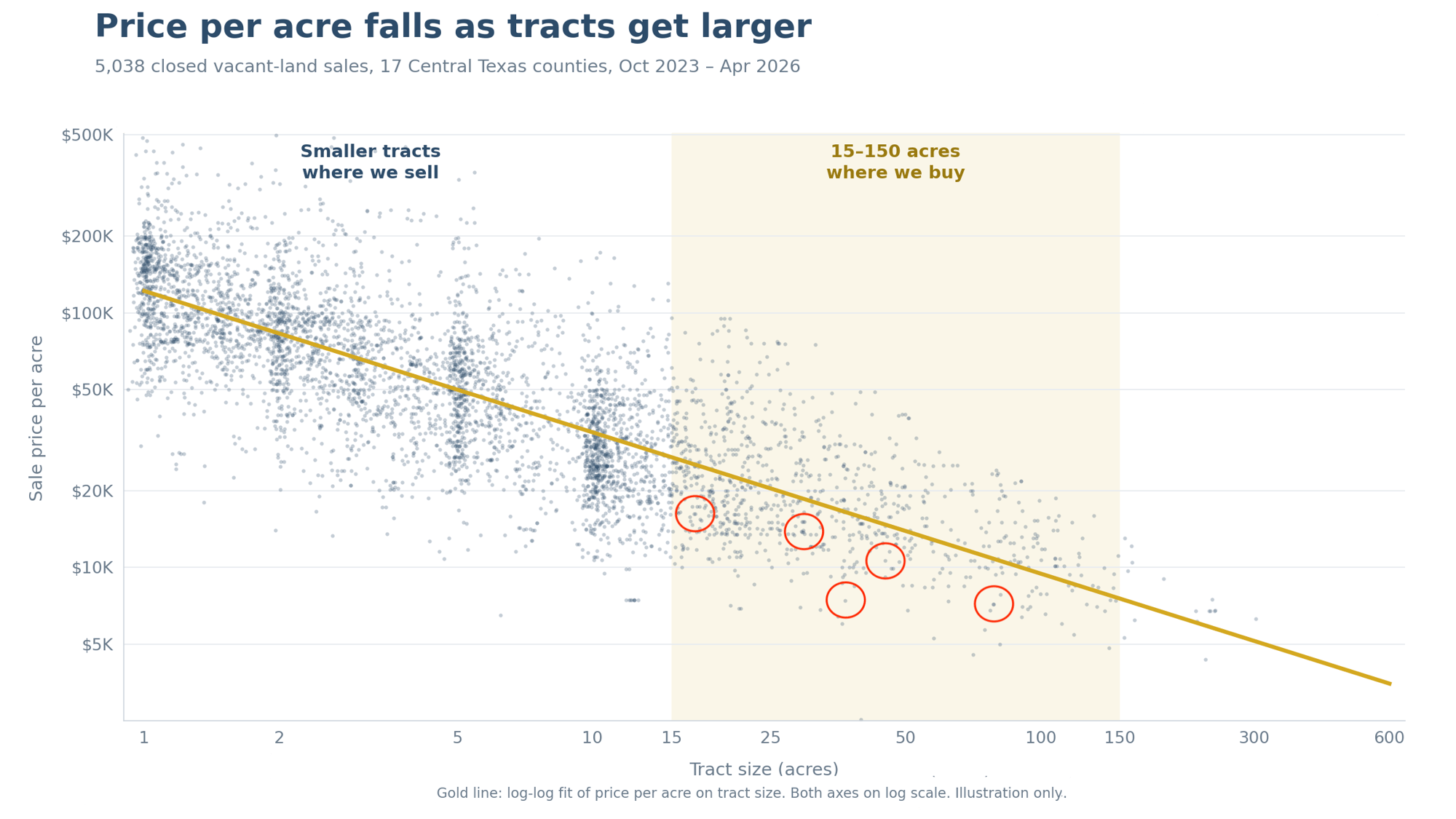
Price per acre falls as tracts get larger. 5,038 closed vacant-land sales, 17 Central Texas counties, Oct 2023 – Apr 2026. Illustrative mock-up of one feature of our model, not the actual model; not a valuation and not an offer of securities.
Intimate Texas Land Knowledge Combined With Institutional-Grade Data
One of the most important skills in real estate investing is knowing what land to buy and what land to pass on.
A lot of that comes down to instinct. Our family has been involved in Texas land for five generations. That heritage, a childhood spent on acreage in the Texas Megaregion, and 30 years between us of evaluating properties tell us what makes a tract desirable before we run a number. But we never rely on instinct alone.
We study and filter properties using an institutional-grade analytics platform built by Managing Partner Mark Cochran, who built the same kind of models for a multibillion-dollar REIT, Bain Capital Real Estate, and a Texas private equity real estate firm. It isn't AI. It's statistics run on thousands of closed sales, isolating how much each feature, such as a gravel road, a floodplain, or road frontage, raises or lowers a tract's price in a given county. Our data tools scan thousands of active listings and rank them by their potential for upside. We winnow the list, then model the best. By the time a capital partner sees a property, we have screened thousands and modeled and visited dozens. Each one is chosen not just for its numbers, but for how well it fits a strategy we've already worked out: how the land will be divided, improved, priced, and sold.
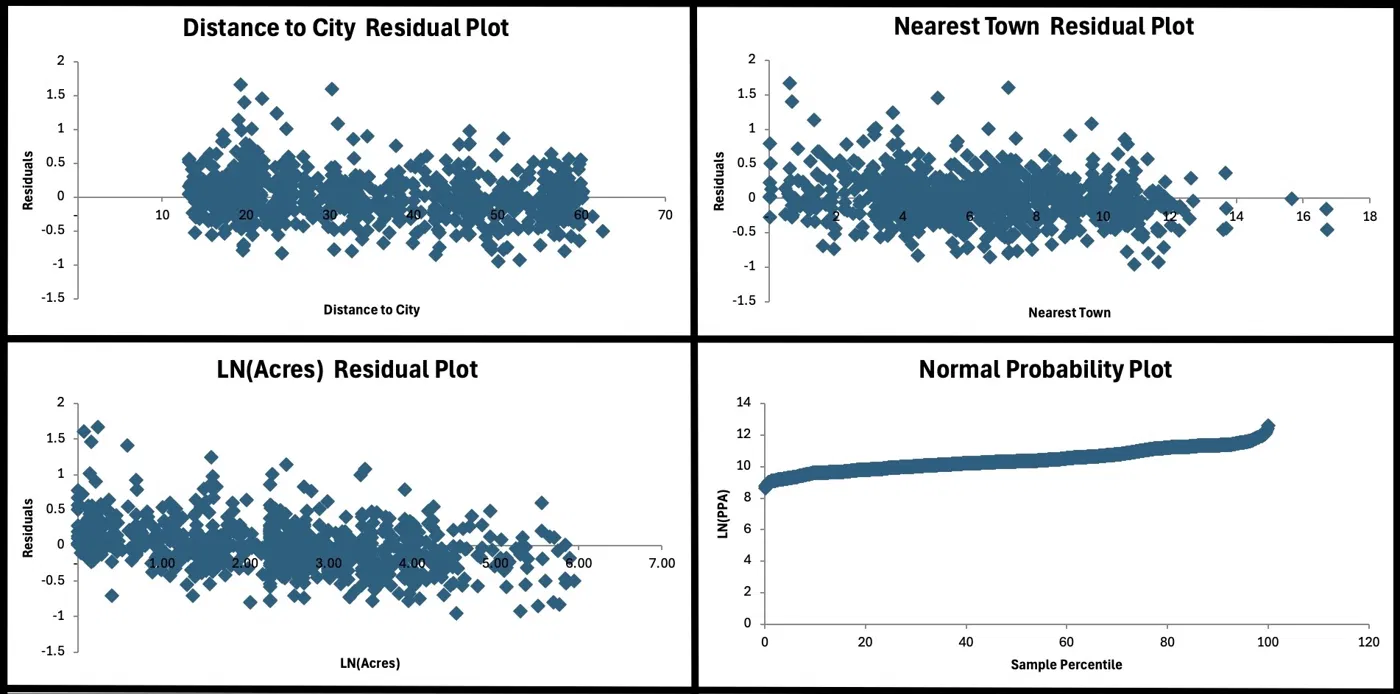
Model diagnostics. Residuals against distance to city, distance to nearest town, and the natural log of acreage show no structural pattern, and the normal probability plot tracks a straight line, supporting the model's assumptions.
Our Process
- 1
Find.
Our analytics system screens thousands of Texas listings, checking each for floodplain, slope, access, and comparable sales. It measures the price gap between large tracts and retail tracts nearby. We model dozens of tracts for every one we buy.
- 2
Strategize.
Before we buy, we plan the project. We lay out how the land divides, set prices from recent local sales, and measure how fast similar tracts sell, how long they sit, and how much is competing for buyers. We project where growth is headed, so we know the outcome before we commit.
- 3
Verify.
Before we make an offer, we confirm mineral rights, utilities, access, and title. During the option period, we resolve any problems before we close.
- 4
Divide.
Wherever we can, we use state and county exemptions that streamline approval, sometimes in as little as two months.
- 5
Improve.
Private roads, utilities, gates, and access.
- 6
Sell.
We sell into proven local demand, with conservative assumptions about price and pace.
Safety Margin
We are disciplined by design — cautious, deliberate, and selective. By the time a tract reaches investors, we have screened thousands, modeled hundreds, and walked dozens. We stay close to each local market, track how fast tracts are selling, and model every deal against a downturn before we buy. We select only projects where retail tracts sell for at least three times the parent tract's price per acre, so even after development costs, land values would have to fall by more than 40% before any of our projects would be at risk of losing money. During the 2007–09 crash, Texas rural land fell less than 20%. Low holding costs mean we're never forced to sell into a weak market.
Want to learn more?
[1] Texas Real Estate Research Center at Texas A&M University, Land Market Report, as reported by The Land Report.
[2] Texas Real Estate Research Center at Texas A&M University, "Rural Land, Summer 2025".