
Emerging Coast — Investment Thesis
The Texas
Triangle Megaregion
Texas isn't growing city by city anymore. It's growing as a system.
The Texas Triangle — Dallas-Fort Worth, Houston, San Antonio, and Austin — forms the fastest growing megaregion in the world.
This isn't just population growth. It's the formation of a new economic geography — one where the spaces between cities matter as much as the cities themselves.
The Thesis
The corridors connecting
these metros are filling in.
Infrastructure is following people. Land that was ignored a decade ago is now in the path of something inevitable.
We work inside this megaregion. Not in the cores, where prices have already run, but in the growth corridors — the counties and communities absorbing expansion pressure from every direction.
This is where the arbitrage lives.
The Region
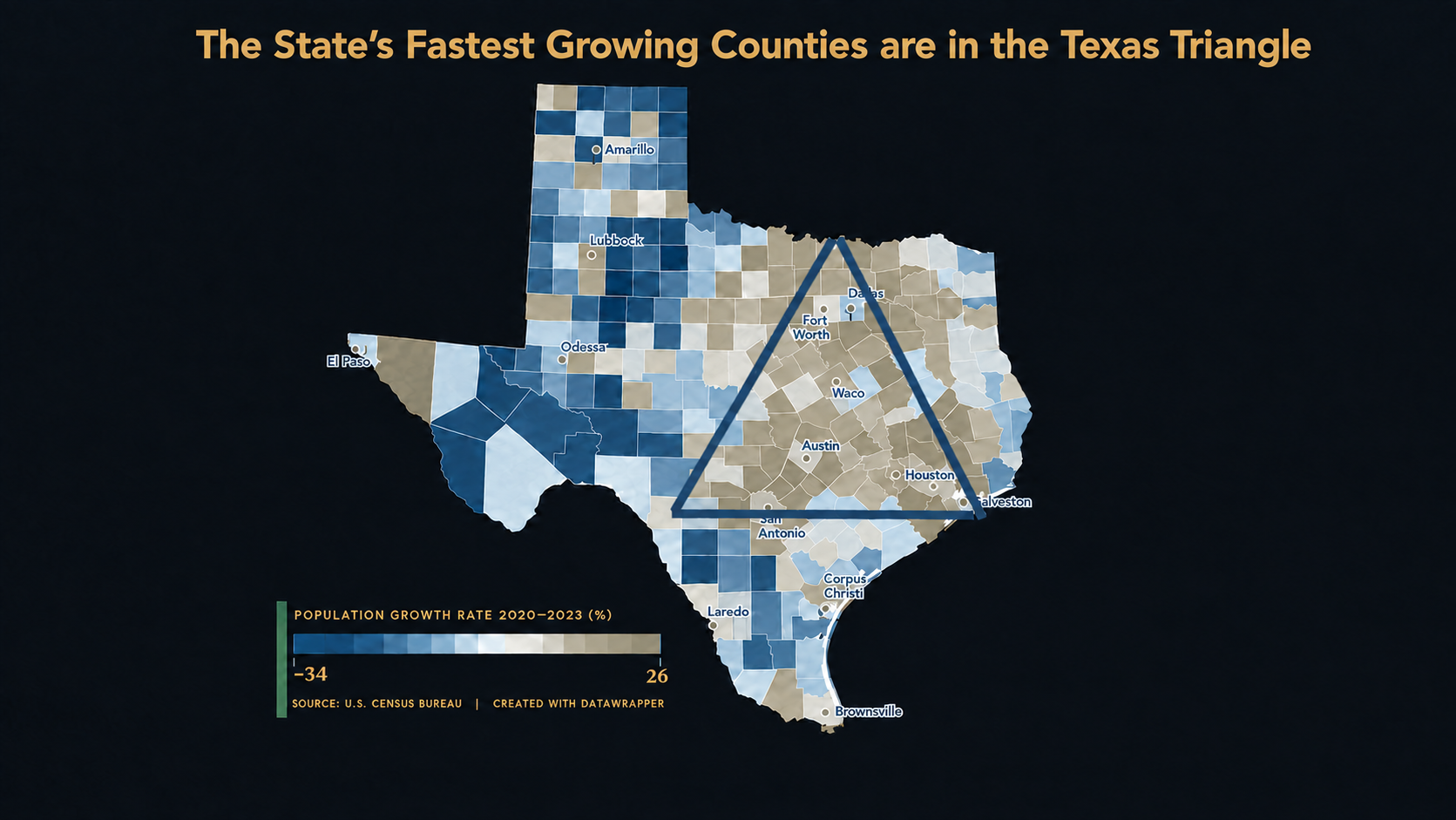
Texas Triangle Megaregion
Fastest growing counties by population growth rate, 2020–2023
Structural Advantage
Why Texas
Texas doesn't have a single growth story. It has five running simultaneously.
Satellite Imagery
Time-Lapsed Growth Corridor Development
Decades of expansion captured in seconds — the corridors are not hypothetical.

Frisco / North DFW Corridor

Katy / West Houston Corridor
Historical Context
This Has Happened Before
Every generation has its megaregion moment. The pattern is consistent — the window is finite.
The BosWash corridor absorbed post-industrial restructuring. Land between cities — New Jersey, Connecticut, Maryland — transformed from farmland to suburb to exurb. A generation of wealth was built in the spaces.
The Pacific megaregion — LA to San Diego, SF to Sacramento — compressed geography and inflated prices. Those who held land in the growth path saw generational returns. Those who arrived late found the arbitrage already gone.
This is that moment, playing out in real time. The corridors between DFW, Houston, Austin, and San Antonio are where the story is being written. Lower basis. Higher ceiling. Less competition. More time.

The land is still priced like the past.
The trajectory is not.